There are two German girls who are visiting the family for a week and it has been interesting to think about culture. German culture is similar to Canadian culture in many ways, but there are many small differences. We can relate to each other on many subjects, for instance the glances to each other with shared feeling that this is crazy that we are sitting in a thatched roofed hut drinking locally brewed beer our of calabashes with drunk elders sitting across the way, or the initial strangeness of eating with your hands, or the giggles at huge 'packages' animals of all shapes and sizes have here…but these girls have grown up in a different culture than I did, they speak a different language and have a different perspective. Having had time to see the impact of Europe on Ghana, I see the impact of Europe on Canada. We are all so connected and we don’t fully realize the extent (at least I don’t).
Just as many Canadians have a skewed vision of Ghana and Africa, many Ghanaians have a skewed image of Canada and North America. They catch glimpses of our culture through movies, “Desperate Housewives”, Revlon commercials, Celine Dion and hip-hop videos. At first I felt ashamed that one of the major cultural things that has flown into my house in Damongo is Akon and Shaggy music videos and random blockbusters, worried about what they thought about how frivolous and excessive we are in North America, then I realized, this has become of their culture. This hip hop music is theirs…just the way many of us can identify with Bob Marely’s songs, we know he is Jamaican, but that doesn’t mean his songs aren’t part of our culture.
So what is culture, whose culture is whose? Does it matter? What implications are the images (that many of us in Canada wouldn’t be proud to portray as who they are) that Ghanaians see of Canada? I don’t know. Let’s look at it the other way, what are the implications of what we see of Africa on the news? Think about what your impression of Africa is, and what the perception your family and friends have of Africa. What impact does this have on our actions or opinions towards Africa, consciously or subconsciously?
Many Ghanaians don’t even differentiate Europe and Canada, because compared to Ghanaian culture, ours are very similar.
Even if this train of thought is useless, it’s interesting to see snippets of different cultures integrated together. What’s the value in identifying where certain cultural aspects derived from? Is there any. For one, it shows history and how we are all connected, and that we have the potential to impact people around the world without being aware of it. One of the big implications that I can see is the choices we make in Canada really do impact Ghanaians. The fact that there is a market for people in Canada who want to buy ethical products like those from the body shop (shea butter creams from women’s groups in Busunu for instance) impacts people here. People are aware that in Canada you aren’t supposed to just throw trash on the ground. But what are other aspects of our culture that we are proud of that Ghanaians aren’t aware of? How did it come to pass that rap videos, big cars and blockbusters are the things that have come from our culture? Ease of distribution, Ghanaian preference? Not to condemn all rap videos, but personally I find many of them to be excessive, violent and degrading to women. That’s not something that I feel represents what Canada is all about. If in Canada we make responsible choices about how we live our lives, what impact will that have?
Just some thoughts that I don’t know how to sort out so I thought I would share them! Let me know what you think.
Sunday, July 13, 2008

Friday, July 11, 2008
Morning in the Life of a JF in Damongo
5:00 am bowel wake-up call. I am lucky to be living in a compound that is blessed with a toilet…no seat, but no worries. Fumbling in my room for my flipflops and toilet roll, resistant to turning on the light because it will wake me up too much, I make it out the door and to the toilet. Grab a bucket, fill ‘er up from one of many places (I try and find the least useable water so as not to 10 L of good water on a flush) and fill the back of the toilet and proceed to flushing.
6:30 am: the roosters and girls who are sweeping are determined to disrupt my sleep…so is the need to pee, but I stick my head phones in my ears and try to ignore the world for another 30 minutes.
7:00 am: ok, now its time to get up. Stretches, sit-ups and a few measly pushups and its time for a bath.
Emerge from my layer, greet the people in the house, who seem less enthused and energetic than I am trying to muster up (maybe if they went to bed earlier…everyone in the house goes to bed so late, even though they wake up at 5:30am.)
7:15 am, bucket shower time. some days it’s a welcome wake-up call…somedays when its rainy and cold…a little bit of a struggle. Wrapped up in my cloth, my small bucket containing my sponge (impossibly long mesh thing that when bunched up is like a rough loufa), face wash and shampoo, I make my way to the bath-house. I use my small bucket to scoop water from the bigger bucket, and dump on my sleepy body…I usually acquaint the first dump with jumping in the lake at camp. Refreshing and exhilarating, but scary! The soap I use is one of the one's my host mother makes...all natural ingredients, nice scent and lathers well!
7:30 am: breakie with the fam. This consists of bread and tea normally (I know, tea in Africa when its so hot!? You get used to it, and these days, its rather chilly). Kids are leaving for school, and me, bede (host brother) and the parents are getting ready to go to work, so the household is moving, dynamic and busy, but there is usually someone else sitting with me enjoying breakfast and a nice chat. The tea is delicious, let me describe:
-Tetley tea bag (by far the best variety here)
-local honey (its really dark and has a smokey rich taste)
-‘ideal’ condensed milk from a small little can (delicious…though I’ve stopped taking it due to my antibiotic ridden stomach, dairy isn’t so good for it)
I’ve introduced groundnut paste to the morning ritual, which is delicious. Organic fresh peanut butter is a good way to start the day. but there is some risk involved, because I am pretty sure is not a Ghanaian thing to eat groundnut paste this way, even though the kids join in and love it. mostly groundnut paste is used in soups and stews, boiled to death, so good hygiene may not always be practiced when dealing with it raw. So far the risk has felt worthy of the benefit.
7:50 am…iron my clothes! Just because I am in Africa doesn’t mean I can be wrinkly…people are very conscious of their appearance, and wrinkles are not acceptable! I have never ironed properly in my life, so I think its funny that I have started in Ghana. I am no domestic goddess, so ironing some of my things often is unsuccessful anyway, but I need to try! Though I have been lovingly scorned that you shouldn’t be ironing your clothes the day of…but I don’t see why not.
8:15 am: jump on my bike and head to work. I carry my computer in my bag with me, usually wrapped up in a rubber (plastic bag) in case of sudden rains. I say hello to a few of the regulars I pass…Ashumaa! Awoo (good morning! Fine.)
Lanto de noosa? Awoo (how is your house? Fine).
Adesba de Noosa? Awoo (how was your sleep? Fine)
Lanto bi? Alanfia (how are the people in your house? They are well)
And so on.
Today I stopped for a boiled egg on the way to work. Food vendors sell boiled eggs, and you can just eat them like that (no plate!), or you can get it with hot pepper and onion. I just eat it straight. I clasped it in my hand, and soared down the hill. I make the sketchy transition from paved to dirt road and continue on for some way. I stop at the side of the road to eat my egg. I crack it on the bicycle handle, and begin to peel away at it. here it is customary to just litter on the ground, and even though this is just an egg shell I am dropping, I still feel like the two farmers who are passing me on their bike are going to yell at me for littering. Obviously they don’t, they greet me and continue on their way. The egg is delicious and creamy, I am satisfied and continue on to work. The day will be tough, but I have a bit of plan today, so I am feeling better than most days, and its cool out and I am not even sweating, that has to be a good sign!
Sunday, July 6, 2008
Midsummer Retreat
All the JFs together again at Mole National Park:
 This past weekend all the Ghana JFs and most of the LTOV made the trip to Damongo to have our midsummer retreat. Overall the retreat was a success, as I heard the Ontario EWB retreat was as well. Seeing everyone pour out of the dusty little tro-tro (dangerous out of date van that sits 3 times as many people as its supposed to) warmed my heart. All those people who have been kicking around Ghana like me for the past 7 weeks, tanned vibrant and full of smiles, gave me hope that maybe some outward change had happened in me too.
Since I am in Damongo, I was organizing some of the logistics, and let me say, organizing stuff here is way different than back in Canada. Here, its everyone’s business, and even if you have a local helping you, the next person you meet scorns you because they could have done a better job or gotten you a better connection or deal. And having been through the experience, people do genuinely want to help you, but they also want to help their friend or cousin who is a driver or who makes food that they can hook up with a bunch of ‘Cabrunis’ (foreigners). People make promises or assure you that things will happen, but without a whole lot of nagging, things don’t just happen here. It also isn’t in the general Ghanaian nature to plan more than a few days in advance or adhere to strict timelines. But, in the process I made a friend and learned a lot, so what more can you ask for? (Above: At the Mahama Guest House where we were holding our conference)
The first day was spent updating each other on our placements, the second day was a fun day at Mole National Park, and the last day was strategizing next steps for the rest of the summer. Unfortunately after all that planning and anticipation, I was sick for about half of the activities, but I did have some very valuable conversations with people, and gained a little bit of insight on what I can be doing with the remainder of my time.
Some fun tidbits, we all (despite the fact it makes some of us sick still) were devouring and loving the Ghanaian food, and laughing each other as we were speaking with a Ghanaian twang to our English (which sometimes results in grammatical blunders). For example, when you are looking for the name of something: ‘one minute, we are just finishing our, this thing.’ And, the words:
-Plenty (its used in place of ‘a lot’. i.e., There are plenty of stars in the sky tonight, there are plenty of flies)
-Small small (do you want pepe? Small small.)
-Oh, sorry (as in, you trip and your co-worker says ‘oh sorry’, because you are a fool who can’t pick up your feet, but they make it sound nice)
-Ahaann (sound of excited understanding)
-Pick (as in, ‘I am going to pick him on my bike’, or ‘I am going to pick some bananas from town’) -how is it? oh, fine.
Mole was fun. It was amazing to go and trump around in the bush with wild animals around with a guide having a rifle strapped to his back. Here are some sweet elephant shots! There was also a pool there…pretty sketchy and dangerous as it was super murky, unsupervised and very deep, but even the lifeguard in me was way too eager to jump into that buggy murky chloriney mess because I miss swimming so much! Leaving for the Tro-Tro to Mole, where we sang many fun camp songs and oldies!

 Dung Beettles working away rolling poo
 Our Fearless Guide leading us through the bush
 Me and Bevan, anotherJF, with an elephant skull!
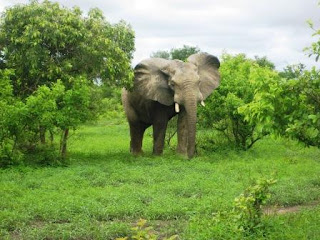 An elephant up close and personal
 me and an elephant up on a hill, they were strange, climbing very high. they reminded me of dinosaurs
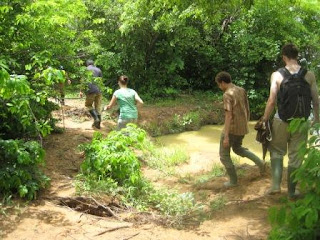 trekking along...2 hours in the heat is hard
 Warthogs, aka "Pumba and his wife spooning"
 Swimming fun at the Mole Hotel
It was really amazing to spend time with the 5 longterm volunteers who were able to make it out. They are such wonderful, passionate and inspiring women (they all happened to be women). With great advice and support as we poor JFs struggle to figure out how to have impact in our remaining month and a half, when it usually takes at least the first 3 to 4 months of a long-term placement to get your feet on the ground. The whole overseas program in Ghana is slowly restructuring, so that JFs are beginning to contribute more to the work of longterm volunteers, helping to focus our short time that we spend here. Due to unfortunate circumstances, I happen to be a relic of the past system, of ‘go work in this office and see what could be improved…go!’, which is super hard let me tell you, but as frustrating as it is, a great learning experience.
 This past weekend all the Ghana JFs and most of the LTOV made the trip to Damongo to have our midsummer retreat. Overall the retreat was a success, as I heard the Ontario EWB retreat was as well. Seeing everyone pour out of the dusty little tro-tro (dangerous out of date van that sits 3 times as many people as its supposed to) warmed my heart. All those people who have been kicking around Ghana like me for the past 7 weeks, tanned vibrant and full of smiles, gave me hope that maybe some outward change had happened in me too.
Since I am in Damongo, I was organizing some of the logistics, and let me say, organizing stuff here is way different than back in Canada. Here, its everyone’s business, and even if you have a local helping you, the next person you meet scorns you because they could have done a better job or gotten you a better connection or deal. And having been through the experience, people do genuinely want to help you, but they also want to help their friend or cousin who is a driver or who makes food that they can hook up with a bunch of ‘Cabrunis’ (foreigners). People make promises or assure you that things will happen, but without a whole lot of nagging, things don’t just happen here. It also isn’t in the general Ghanaian nature to plan more than a few days in advance or adhere to strict timelines. But, in the process I made a friend and learned a lot, so what more can you ask for?
(Above: At the Mahama Guest House where we were holding our conference)The first day was spent updating each other on our placements, the second day was a fun day at Mole National Park, and the last day was strategizing next steps for the rest of the summer. Unfortunately after all that planning and anticipation, I was sick for about half of the activities, but I did have some very valuable conversations with people, and gained a little bit of insight on what I can be doing with the remainder of my time.
Some fun tidbits, we all (despite the fact it makes some of us sick still) were devouring and loving the Ghanaian food, and laughing each other as we were speaking with a Ghanaian twang to our English (which sometimes results in grammatical blunders). For example, when you are looking for the name of something: ‘one minute, we are just finishing our, this thing.’ And, the words:
-Plenty (its used in place of ‘a lot’. i.e., There are plenty of stars in the sky tonight, there are plenty of flies)
-Small small (do you want pepe? Small small.)
-Oh, sorry (as in, you trip and your co-worker says ‘oh sorry’, because you are a fool who can’t pick up your feet, but they make it sound nice)
-Ahaann (sound of excited understanding)
-Pick (as in, ‘I am going to pick him on my bike’, or ‘I am going to pick some bananas from town’) -how is it? oh, fine.
Mole was fun. It was amazing to go and trump around in the bush with wild animals around with a guide having a rifle strapped to his back. Here are some sweet elephant shots! There was also a pool there…pretty sketchy and dangerous as it was super murky, unsupervised and very deep, but even the lifeguard in me was way too eager to jump into that buggy murky chloriney mess because I miss swimming so much!
Leaving for the Tro-Tro to Mole, where we sang many fun camp songs and oldies!Cop, reminds me of the wax patterns you see on cloth here
Dung Beettles working away rolling pooOur Fearless Guide leading us through the bushMe and Bevan, anotherJF, with an elephant skull!An elephant up close and personalme and an elephant up on a hill, they were strange, climbing very high. they reminded me of dinosaurstrekking along...2 hours in the heat is hardWarthogs, aka "Pumba and his wife spooning"Swimming fun at the Mole HotelIt was really amazing to spend time with the 5 longterm volunteers who were able to make it out. They are such wonderful, passionate and inspiring women (they all happened to be women). With great advice and support as we poor JFs struggle to figure out how to have impact in our remaining month and a half, when it usually takes at least the first 3 to 4 months of a long-term placement to get your feet on the ground. The whole overseas program in Ghana is slowly restructuring, so that JFs are beginning to contribute more to the work of longterm volunteers, helping to focus our short time that we spend here. Due to unfortunate circumstances, I happen to be a relic of the past system, of ‘go work in this office and see what could be improved…go!’, which is super hard let me tell you, but as frustrating as it is, a great learning experience.
Health and Development, oh my!
I’ve been able to gather some more thoughts on some of the challenges Ghana, and for that matter much of Africa and the developing world, face when struggling to alleviate poverty. This, very simply and brutally obvious now that I am here, are matters of health.
One of the links between hot climates and poverty is all the diseases that come along with hot, wet weather (yet another argument for combating climate change). Just to name off a few of the common diseases: malaria, yellow fever, typhoid fever, bacteria (e.coli, cholera, etc), parasites, worms, with which comes a horrific array of symptoms, most of which include unrelenting diarrhea, abdominal pains and fever. But in Canada we have colds, throat infections and the flu, that’s pretty bad…much to my lucky surprise these are also common afflictions in the rainy season here as well. Oh, and don’t forget the side affects of the medications that you take in vain to try and avoid these sicknesses. Not being the strongest person at fighting off illnesses to begin with, I knew I would have challenges with health, but I never knew the kind of frustration that ensues. Since I have been here I have basically been sick the whole time with one thing or another, and had some interesting experiences at the Damongo hospital and “Licensed Chemical Sellers” (aka pharmacies) around town. Being sick in Ghana is frustrating, and its not just because I am a foreigner either. Everyone is getting sick. The rainy season is beautiful and a nice temperature, but it’s the disease season.
For me, I am frustrated because I want to be at work and doing things to help people and do something useful while I am here, but sometimes, am not able to go. Sure I can find other things to do with my time if it’s something ‘mild’ and I can think clearly (like right now), but what kind of impression does it make if I miss most of the work week? How can I get frustrated at my coworkers for not working hard or having an unmotivated attitude if I am not even at work? People here understand when you are sick…that’s why sometimes things take a long time to get underway. That’s just in the office though, and I am just a volunteer. What if feeding, housing and clothing yourself and your immediate AND extended family depended on it? Working at anything, even if it is just around the house when you are riddled with energy-sucking parasites and shaking with a fever is not easy or enabling people to help themselves.
The Damongo hospital is very nice, I am a regular now, got some friends who work there, which is embarrassing, but nice. I shamefully get shuffled to the front of the lines after they leave me in a huge mob of a line for about 15 minutes when I say I want to wait, but I still wait there all day, so it doesn’t really make too much of a difference in the end. When you arrive, you give in your identity card and health insurance if you have it. Then you sit in a big line, they retrieve a card that has your health info on it. Then you wait. Then you see a nurse and she takes your temperature, blood pressure, pulse and weight (where I always realize how unhealthily light I have become). Then you wait to see a doctor. You see them, and then they say to get a bunch of tests done. Malaria is always tested for in this season (and usually the default treatment, because the symptoms are so diverse and there are so many strains) and its usually accompanied by a stool sample. Nurses, doctors, bio-statisticians and lab technicians are all very friendly and professional (unlike what I was warned of before I came, which is comforting). For the malaria test, they prick your finger and smear it on a slide, and for the stool test, well, you poop in an impossibly small jar, but they only need a little, as they reminded me after my first exasperated attempt. Then there is plenty of waiting. I admire the people who are waiting. It is mostly mothers and babies, small kids and old men. There are very few who complain. They sit in on wooden benches (the sides are open to the outside, so thankfully there is a nice breeze coming through), packed together in their beautiful cloth, for the most part quietly. It works like a clinic that takes a really long time, and you don’t get much personal attention, your test results speak for you. So usually about 3 hours later, you make your way back to the doctor, show him the results and he writes you a prescription, go to the pharmacy and pay and pick it up and go home with baggies of medicine, feeling worse than when you came, as is usually the case at any health centre.
The frustrating thing is, if your results don’t do your symptoms justice, oh well…then comes the dangerous game of playing doctor yourself. For those who can’t afford to wait or to pay for the hospital visit, you must diagnose yourself. It’s frustrating to always be sick and to have so little control. To give you an idea about self-diagnosing, some drugs that require a prescription at home can be bought over the counter at a low price…Flagyl, used to treat parasites cost me 20 peswas (the same amount I pay to buy 5 bananas, or a bag of groundnut paste, or a meal in town)…this is very cheap! Coming into Ghana it was recommended that I take an antibiotic ‘cipero’ for bad diarrhea, and I was confused when nobody knew about it and was always talking about this Flagyl. Well the difference is, cipero costs 2.50 whereas Flagyl is 0.20. That says it right there, so whether the locals or the travel doctor has it right, the cheapest drug clearly become the drug of choice when self-diagnosing.
What’s my point? Health is important to development!! Painfully obvious, but worth reiterating. Good healthcare services and education, sanitation and clean water are vital. In Canada I think these things get taken for granted because aside from a few cases we can count on one hand, contaminated water, food poisoning and endemic viruses are not our primary concern. I am feeling the weight and importance of what I am learning in school more and more. Partially the people here are really unlucky because these causes of illnesses are more prevalent because of climate, but so many of these sicknesses are preventable, or would be less disruptive with a more efficient system. I think Damongo has a pretty good facility, better than I was expecting, but its no where near as good as how we have it in Canada and it serves not just the people in Damongo, but all the surrounding villages of the district.
One of the links between hot climates and poverty is all the diseases that come along with hot, wet weather (yet another argument for combating climate change). Just to name off a few of the common diseases: malaria, yellow fever, typhoid fever, bacteria (e.coli, cholera, etc), parasites, worms, with which comes a horrific array of symptoms, most of which include unrelenting diarrhea, abdominal pains and fever. But in Canada we have colds, throat infections and the flu, that’s pretty bad…much to my lucky surprise these are also common afflictions in the rainy season here as well. Oh, and don’t forget the side affects of the medications that you take in vain to try and avoid these sicknesses. Not being the strongest person at fighting off illnesses to begin with, I knew I would have challenges with health, but I never knew the kind of frustration that ensues. Since I have been here I have basically been sick the whole time with one thing or another, and had some interesting experiences at the Damongo hospital and “Licensed Chemical Sellers” (aka pharmacies) around town. Being sick in Ghana is frustrating, and its not just because I am a foreigner either. Everyone is getting sick. The rainy season is beautiful and a nice temperature, but it’s the disease season.
For me, I am frustrated because I want to be at work and doing things to help people and do something useful while I am here, but sometimes, am not able to go. Sure I can find other things to do with my time if it’s something ‘mild’ and I can think clearly (like right now), but what kind of impression does it make if I miss most of the work week? How can I get frustrated at my coworkers for not working hard or having an unmotivated attitude if I am not even at work? People here understand when you are sick…that’s why sometimes things take a long time to get underway. That’s just in the office though, and I am just a volunteer. What if feeding, housing and clothing yourself and your immediate AND extended family depended on it? Working at anything, even if it is just around the house when you are riddled with energy-sucking parasites and shaking with a fever is not easy or enabling people to help themselves.
The Damongo hospital is very nice, I am a regular now, got some friends who work there, which is embarrassing, but nice. I shamefully get shuffled to the front of the lines after they leave me in a huge mob of a line for about 15 minutes when I say I want to wait, but I still wait there all day, so it doesn’t really make too much of a difference in the end. When you arrive, you give in your identity card and health insurance if you have it. Then you sit in a big line, they retrieve a card that has your health info on it. Then you wait. Then you see a nurse and she takes your temperature, blood pressure, pulse and weight (where I always realize how unhealthily light I have become). Then you wait to see a doctor. You see them, and then they say to get a bunch of tests done. Malaria is always tested for in this season (and usually the default treatment, because the symptoms are so diverse and there are so many strains) and its usually accompanied by a stool sample. Nurses, doctors, bio-statisticians and lab technicians are all very friendly and professional (unlike what I was warned of before I came, which is comforting). For the malaria test, they prick your finger and smear it on a slide, and for the stool test, well, you poop in an impossibly small jar, but they only need a little, as they reminded me after my first exasperated attempt. Then there is plenty of waiting. I admire the people who are waiting. It is mostly mothers and babies, small kids and old men. There are very few who complain. They sit in on wooden benches (the sides are open to the outside, so thankfully there is a nice breeze coming through), packed together in their beautiful cloth, for the most part quietly. It works like a clinic that takes a really long time, and you don’t get much personal attention, your test results speak for you. So usually about 3 hours later, you make your way back to the doctor, show him the results and he writes you a prescription, go to the pharmacy and pay and pick it up and go home with baggies of medicine, feeling worse than when you came, as is usually the case at any health centre.
The frustrating thing is, if your results don’t do your symptoms justice, oh well…then comes the dangerous game of playing doctor yourself. For those who can’t afford to wait or to pay for the hospital visit, you must diagnose yourself. It’s frustrating to always be sick and to have so little control. To give you an idea about self-diagnosing, some drugs that require a prescription at home can be bought over the counter at a low price…Flagyl, used to treat parasites cost me 20 peswas (the same amount I pay to buy 5 bananas, or a bag of groundnut paste, or a meal in town)…this is very cheap! Coming into Ghana it was recommended that I take an antibiotic ‘cipero’ for bad diarrhea, and I was confused when nobody knew about it and was always talking about this Flagyl. Well the difference is, cipero costs 2.50 whereas Flagyl is 0.20. That says it right there, so whether the locals or the travel doctor has it right, the cheapest drug clearly become the drug of choice when self-diagnosing.
What’s my point? Health is important to development!! Painfully obvious, but worth reiterating. Good healthcare services and education, sanitation and clean water are vital. In Canada I think these things get taken for granted because aside from a few cases we can count on one hand, contaminated water, food poisoning and endemic viruses are not our primary concern. I am feeling the weight and importance of what I am learning in school more and more. Partially the people here are really unlucky because these causes of illnesses are more prevalent because of climate, but so many of these sicknesses are preventable, or would be less disruptive with a more efficient system. I think Damongo has a pretty good facility, better than I was expecting, but its no where near as good as how we have it in Canada and it serves not just the people in Damongo, but all the surrounding villages of the district.
Sunday, June 22, 2008
Busunu Love!
This past week I spent in Busunu and had an amazing experience! It was wonderful to get perspective on different lifestyles of Ghanaians and appreciate the hardships of the rural clients of REP.
While in Busunu I split my time between participating in the activities of the women around the house (cooking, sweeping, processing shea nuts, etc.) and walking around the village interviewing clients who had received one of three trainings over the past year, beekeeping, batik tie and dye, and soap making.
I was incredibly fortunate that the family/compound I was staying with was so amazing and friendly, and I had a community leader who spoke English fluently to help guide me around to the various clients.


Busunu is a very interesting community that has had many different development projects passing through it, from various water installations to renewable energy to sponsorships from the Body Shop. It was good to see the impacts of the projects and the different approaches to development. For instance, you can have a private company like the Body Shop sponsor a women’s group who process shea nuts, you can have a government sponsored project like REP training people in new skills to start businesses, or you can have partnerships between universities and churches to fund pilot energy projects, or huge NGOs like World Vision coming in and supporting children through feeding programs and schools. This community had it all.

(this women's group says below, it is hard to read, "sponsored by the Body Shop"!)
 And the community was developing and changing. The project that had the biggest noticeable impact was the renewable energy project. Over the past 6 months a large number of houses in the community were set up with electricity, consisting of 2 light bulbs. This has changed a lot about the community already. It has changed the dynamics of the family at night, they are able to cook later, and socialize more, there is a sense of security and safety, they are able to have cell phone because they can now be charged, and new businesses will be able to be started up (welders, more machinery, etc.). The price is better than the national grid and way better than kerosene that would be used for lamps.
Let me tell you a bit about it, because as an environmental engineering student, I found it incredibly interesting.
The main source of power is solar, but there is a naturally occurring plant in the area, jatropha, whose seed contains oil that can be used as bio fuel that powers the back-up generator when the sun is weak. The electricity lines are all underground, and the houses are metered to keep track of usage. The project is encouraging people to be growing the jatropha on their farms and around their homes as a fence, and then the project buys the seeds from them. They can use the seeds as their payment for their electricity, or just to make some extra money.

The energy facility with the solar panels and generator
 Sakara, my guide and friend, showing the Jatropha plant (seeds below)
 The project is still just starting up, so they are still running the backup generator on diesel, but soon hope to move to the bio-diesel soon. Overall the project seems sustainable, and is being implemented slowly over a couple of years, with the aim of being self-sufficient. If it is successful, then they will implement it in other areas. The classic problems remain with projects like this...if a part of the machinery for the solar panels breaks, they have to send it to Germany to repair it. The idea of the project came from some pilot projects that were done in Kenya with the Jatropha plant, if you are interested in further research (which I definitely am, so if you get a head start, let me know!).
The family that I stayed with was wonderful, in particular my friend Gifty. She’s a couple years older than me, but intelligent, friendly and just such a beautiful person! She had an adorable 5 month old baby who you couldn’t help but love, and she let me help her out and get to know the way she was living in Busunu.
 She grew up there, but has since moved to Tamale for seamstress training and will leave Busunu in a couple months when the baby, Johnson, is older. I was sad to leave, because I learned more from her on what it means to be an African woman in a week than I have in the 6 weeks I have been here. Here are some pictures and I hope to be able to visit Busunu again to say hello to my friend again, I don’t know if she will ever know what an impact she has had on me.
 Shea Nut Madness!
Walking around the Busunu in the morning is like walking through a ghost town, taken over by packs of 2 year olds and the occasional granny watching over. Why? Because of Shea Nuts! All of the women in Busunu (and most of those in the West Gonja District) are out in the Bush before the sun rises to collect shea nuts.
So why are the shea nuts such a big deal? Because for the majority of those living in Busunu, this seasonal work will generate their income for the entire year. This year women are particularly serious about it because the price is high for selling and the fruits are growing well. So when it is shea nut season (it has been going on for maybe 3 weeks now, and will last for maybe 1 to 2 months still) everything else stops, and collecting and processing the shea nuts become the priority. Learning about how women (who are REPs main target beneficiaries) spend their time was amazing as I am beginning to better understand about the daily struggles and challenges they face, and how the intervention by the REP could potentially impact their lives.
So let me take you through the process:
1. Shea fruits grow on trees in the ‘bush’. They kind of remind me of avocadoes; they are green and have a pasty fruit on the inside with a large nut in the middle. They can be very sweet…but take care when they are that sweet (as you will see soon)…but mostly they taste like plain yogurt to me. The bush is the wilderness that exists outside of town. Since we are further north, it’s not as dense as a rainforest, but is just as green…check the picture:
2. Shea nuts fall from trees. This is where the women come in with their sacks and basins to come and collect them. I accompanied some of the women one day into the bush and what an adventure we had! It was HARD work! Cutting off the road and heading into the bush some times along paths, sometimes just cutting through randomly (I don’t know how we didn’t get lost) moving to one area, stopping and bending over to pick the fruits through the grass, putting them in the bin and moving on…again and again, hard work!


3. Once you have collected all that you can carry, you put it on your head, and take the long walk back into town. For me, my neck would break if I tried to carry that weight, but instead I carried my backpack wrapped up in a rubber bag on my head, emerging from the bush a little bit more African, but still very much a silly white girl.

4. Boiling. The shea nuts are covered in rotten fruit and flies, so all that gunk is boiled off in a big cauldron.

5. Drying. The nuts are spread out on the ground to be dried by the heat of the African sun. They are spread out and quite frequently have to be protected from hungry and relentless goats and pigs.


 9. Extracting the oil. This part I was not able to witness. I am not sure how it is done, but I believe it involves boiling. I believe there is a press that can be used, but again, I am pretty sure that no machinery is used by the women in Busunu. Furthermore, the nuts can be stored this way for up to a year and can be traded and sold this way to those who will go on to process it for the oil.
I was excited to participate in all the steps of the process…but quickly learned it’s no game. Since everything is done by hand, and you have such large quantities of nuts to process…each task quickly becomes very tedious and blister inducing. I was fortunate to just have a taste of all the different steps, and I didn’t need to suffer every morning to get up and go into the bush if it had rained all night or if my muscles were aching. So I got a taste of it, but still I will never really know.

I have a better appreciation for rural livelihoods as a result of this trip for many reasons. First, the women had no choice but to be dragging their tough asses out to the bush every day and collecting these nuts. This isn’t a bonus income, this is it, the big deal, so if you don’t do it, you go hungry and your children suffer. There is no choice in the matter.
Everything is dependent on the weather. The reason the shea nuts are growing so well, is because of the weather, if it rains too much, it disturbs the picking, when it is sunny, you come back and spread your nuts out to dry. The weather dictates your schedule.
Everything is done painstakingly by manual labour. Each and every shea fruit that is produced passes through your hands many times before it is ready to be sold. There are no machines, nothing beyond a strainer and a stick to aid the process. But there is a sense of pride that I sensed among the women, a sense of camaraderie and respect that comes from sharing hardwork with someone else. They all understand the struggles they are facing, and for me, unlike what I warned before this village stay, I was not refused hard work, women were hassling me to come into the bush with them to get the nuts and disappointed on the days when I hadn’t gone! These women are so powerful, tough and hardworking, it blew my mind. The women I was collecting the shea nuts in the bush were maybe 50-60 years I think, and they were tough! They could carry more, bend over more and go on for hours like that…I felt pretty weak in comparison.

When I asked my shea nut picking partner whether she enjoyed it (I quickly knew it was a stupid question as soon as I asked it) she said no! she is old and if she had money to buy the shea nuts from someone else she would. All of the women who had received one of the three trainings were all out collecting shea nuts. When I asked what they do for income aside from the shea nuts, many of them said they were just in the house, or doing small selling of food in the market. For the most part the women were excited about having a new skill that could earn them money and give them something to do with their time. The biggest problem they faced was gathering enough money to start up. But they were all incredibly hard working and wanted to start up a business, not just because they had a passion for soap or tye and dye, but because it was a way to make money and be doing something productive with their time. Furthermore, it empowers them to have a skill and a means to be improving their lives that is mostly just dependent on themselves.
So, there has yet to be a positive outcome of the trainings that happened in Busunu, and there wont be more progress until this season is finished, and women will potentially have some income to contribute to their business groups (all the groups of people trained are working together to pool their money to buy resources). I hope that they are able to get started and get going. They are struggling now, but I can see their determination (and desperation) that will lead them to get these businesses started.
I think this village stay was very successful in helping me to better understand the clients, some of the struggles they face, and make that emotional connection, something to keep me working hard and accountable to those people I talked to, to bring about some change that will aid them in their first challenging steps in starting up.
Here’s a challenge for those of you in Canada who are eager to experience some of African life and investigate more into some of these matters.
1. take some time to investigate into the ingredients of some product that you use (whether it be from the Body Shop or otherwise) and try and find where the products come from. If it says a women’s group in Ghana, for instance. Think about what it means. What does it mean to be part of a women’s group. How does it impact their lives? Try and think about the work that goes into the product they are producing and take a moment to wonder at the crazy interconnections that exist in our world, so many of which we are unaware of.
2. do something really boring and tedious all day long. Feel the blisters that will form and the craziness you feel for lack of stimulation. Do this and appreciate the struggles people feel in undergoing work without the aid of machines to quicken the process.
Do you happen to have, or know of someone who has, any skin care products that contain shea butter? I sure do, and how much do we know about this ingredient that is so desired in skin care and makes our skin smooth and supple? Here is some info on shea butter, where it comes from and the hard work that goes collecting it.
So why are the shea nuts such a big deal? Because for the majority of those living in Busunu, this seasonal work will generate their income for the entire year. This year women are particularly serious about it because the price is high for selling and the fruits are growing well. So when it is shea nut season (it has been going on for maybe 3 weeks now, and will last for maybe 1 to 2 months still) everything else stops, and collecting and processing the shea nuts become the priority. Learning about how women (who are REPs main target beneficiaries) spend their time was amazing as I am beginning to better understand about the daily struggles and challenges they face, and how the intervention by the REP could potentially impact their lives.
So let me take you through the process:
1. Shea fruits grow on trees in the ‘bush’. They kind of remind me of avocadoes; they are green and have a pasty fruit on the inside with a large nut in the middle. They can be very sweet…but take care when they are that sweet (as you will see soon)…but mostly they taste like plain yogurt to me. The bush is the wilderness that exists outside of town. Since we are further north, it’s not as dense as a rainforest, but is just as green…check the picture:
2. Shea nuts fall from trees. This is where the women come in with their sacks and basins to come and collect them. I accompanied some of the women one day into the bush and what an adventure we had! It was HARD work! Cutting off the road and heading into the bush some times along paths, sometimes just cutting through randomly (I don’t know how we didn’t get lost) moving to one area, stopping and bending over to pick the fruits through the grass, putting them in the bin and moving on…again and again, hard work!

Furthermore, when I say fruit, you may think of a pleasant, firm, sweet smelling thing, but the majority of what we picked were hidden under grass and shrubs, rotting and covered in bugs. Another special treat was using your hand to push off the fruit before collecting the nut (because you only want the nut, expect for a few fresh fruits that you eat as you go, or take back to the house), and the fruit is being eaten by many maggots, which feel awful on your hand, squirming around, trying to bore into your skin! Ah! There are also hoards of fruit flies around the fruits…its all very natural, so you get over the bug factor pretty quick, but I just want to give you a sense of the work that goes into this, its not like picking apples. 


Along our adventure we faced many challenges (personally my legs, oh god! African women are used to bending over and working, but I am not! The backs of my legs are still killing me, days later, from all that bending!), the rain…the rain came swiftly and viciously and made us finish our work early, and the forest cows, which apparently are mean and are very big with large horns and must be kept at bay with large sticks.
3. Once you have collected all that you can carry, you put it on your head, and take the long walk back into town. For me, my neck would break if I tried to carry that weight, but instead I carried my backpack wrapped up in a rubber bag on my head, emerging from the bush a little bit more African, but still very much a silly white girl.
4. Boiling. The shea nuts are covered in rotten fruit and flies, so all that gunk is boiled off in a big cauldron.
5. Drying. The nuts are spread out on the ground to be dried by the heat of the African sun. They are spread out and quite frequently have to be protected from hungry and relentless goats and pigs.

6. Cracking. The shea nuts are covered in a shell that needs to be cracked to extract the seed/nut that contains the precious oil. So women grab a stick or paddle and wack the nuts on the ground to crack the shells open. 


7. Removing the shells. Now that the shells are cracked, the task of removing all the bits of shell is next. This requires taking one shea nut at a time, taking off the bits of shell (kind of like a boiled egg…sometimes it comes nicely, and sometimes you need to pick at little pieces). There are a few tricks to remove the shells, but one is not really that much easier than the next. You can sit for hours and pick through them, or you can combine it with dumping them from a height from one basin to another and letting the wind carry away some of the chaff, both methods are time consuming and hard work. 

8. Drying. The exposed shea nut is laid out in the sun again to dry.
9. Extracting the oil. This part I was not able to witness. I am not sure how it is done, but I believe it involves boiling. I believe there is a press that can be used, but again, I am pretty sure that no machinery is used by the women in Busunu. Furthermore, the nuts can be stored this way for up to a year and can be traded and sold this way to those who will go on to process it for the oil.I was excited to participate in all the steps of the process…but quickly learned it’s no game. Since everything is done by hand, and you have such large quantities of nuts to process…each task quickly becomes very tedious and blister inducing. I was fortunate to just have a taste of all the different steps, and I didn’t need to suffer every morning to get up and go into the bush if it had rained all night or if my muscles were aching. So I got a taste of it, but still I will never really know.
I have a better appreciation for rural livelihoods as a result of this trip for many reasons. First, the women had no choice but to be dragging their tough asses out to the bush every day and collecting these nuts. This isn’t a bonus income, this is it, the big deal, so if you don’t do it, you go hungry and your children suffer. There is no choice in the matter.
Everything is dependent on the weather. The reason the shea nuts are growing so well, is because of the weather, if it rains too much, it disturbs the picking, when it is sunny, you come back and spread your nuts out to dry. The weather dictates your schedule.
Everything is done painstakingly by manual labour. Each and every shea fruit that is produced passes through your hands many times before it is ready to be sold. There are no machines, nothing beyond a strainer and a stick to aid the process. But there is a sense of pride that I sensed among the women, a sense of camaraderie and respect that comes from sharing hardwork with someone else. They all understand the struggles they are facing, and for me, unlike what I warned before this village stay, I was not refused hard work, women were hassling me to come into the bush with them to get the nuts and disappointed on the days when I hadn’t gone! These women are so powerful, tough and hardworking, it blew my mind. The women I was collecting the shea nuts in the bush were maybe 50-60 years I think, and they were tough! They could carry more, bend over more and go on for hours like that…I felt pretty weak in comparison.
When I asked my shea nut picking partner whether she enjoyed it (I quickly knew it was a stupid question as soon as I asked it) she said no! she is old and if she had money to buy the shea nuts from someone else she would. All of the women who had received one of the three trainings were all out collecting shea nuts. When I asked what they do for income aside from the shea nuts, many of them said they were just in the house, or doing small selling of food in the market. For the most part the women were excited about having a new skill that could earn them money and give them something to do with their time. The biggest problem they faced was gathering enough money to start up. But they were all incredibly hard working and wanted to start up a business, not just because they had a passion for soap or tye and dye, but because it was a way to make money and be doing something productive with their time. Furthermore, it empowers them to have a skill and a means to be improving their lives that is mostly just dependent on themselves.
So, there has yet to be a positive outcome of the trainings that happened in Busunu, and there wont be more progress until this season is finished, and women will potentially have some income to contribute to their business groups (all the groups of people trained are working together to pool their money to buy resources). I hope that they are able to get started and get going. They are struggling now, but I can see their determination (and desperation) that will lead them to get these businesses started.
I think this village stay was very successful in helping me to better understand the clients, some of the struggles they face, and make that emotional connection, something to keep me working hard and accountable to those people I talked to, to bring about some change that will aid them in their first challenging steps in starting up.
Here’s a challenge for those of you in Canada who are eager to experience some of African life and investigate more into some of these matters.
1. take some time to investigate into the ingredients of some product that you use (whether it be from the Body Shop or otherwise) and try and find where the products come from. If it says a women’s group in Ghana, for instance. Think about what it means. What does it mean to be part of a women’s group. How does it impact their lives? Try and think about the work that goes into the product they are producing and take a moment to wonder at the crazy interconnections that exist in our world, so many of which we are unaware of.
2. do something really boring and tedious all day long. Feel the blisters that will form and the craziness you feel for lack of stimulation. Do this and appreciate the struggles people feel in undergoing work without the aid of machines to quicken the process.
3. take a bucket shower! Go ahead, its fun. Fill up a bucket and either use a cup or just your hands to splash the water up onto yourself. Its amazing how well you can clean yourself with less than 10 L, when the average person will take a 10 minute shower, having used about 100 L of water in the process.
Sunday, June 15, 2008
More on the Challenges to Development in Ghana
Road conditions! As Eric Dudely discusses in his book the critical villager, there are many communities that are overlooked in development projects because of their inconvenient location. The village we traveled to this week is in the ‘overseas’ area of the West Gonja district because during the rainy season, it can only be accessed by canoe as the small bridge we were just able to squeak by gets flooded. There is the foundations of a bridge along the road, but its been sitting unfinished for some ten years, and instead, you veer off the road, down a steep slope, over a small concrete slab used as an improvised bridge, and up a steep hill and back onto the road. It was sketchy! And the road is terrible. People in Damongo are aware the road to it from Tamale is bad, but the road to the surrounding villages is worse, if you can call it a road. All those car commercials highlighting the durability and toughness of various trucks and SUVs should be shot along this road! It’s a physically exhausting trip, hence the isolation of the communities along the way.
Through discussions with clients and various other people, the general public does not have faith in the government to help them. A client told me that people are aware of the services of the district assembly and the BAC, but that they don’t feel comfortable going and asking for help because they feel like they will shame themselves by sharing with someone their bad situation, and then still not receive help from them. I feel there is a big disconnect between the government and the people, and the people almost don’t expect anything from the government, because they don’t deliver. Watching the Ghana news at home, all the development projects are going to the south instead of the north where they are more badly needed, so yet again, another reason not to trust the government, or at least, expect disappointment. It’s interesting now that there is an election coming up in December, to see these issues resurfacing.
Through discussions with clients and various other people, the general public does not have faith in the government to help them. A client told me that people are aware of the services of the district assembly and the BAC, but that they don’t feel comfortable going and asking for help because they feel like they will shame themselves by sharing with someone their bad situation, and then still not receive help from them. I feel there is a big disconnect between the government and the people, and the people almost don’t expect anything from the government, because they don’t deliver. Watching the Ghana news at home, all the development projects are going to the south instead of the north where they are more badly needed, so yet again, another reason not to trust the government, or at least, expect disappointment. It’s interesting now that there is an election coming up in December, to see these issues resurfacing.
Subscribe to:
Posts (Atom)


